
Why looking up a word once is usually not enough
When the definition is open in front of you, the word can feel familiar. That feeling is useful, but it is not the same as being able to recall the meaning tomorrow while reading, writing, or speaking.
A lookup answers “What does this mean?” Remembering asks a harder question: “Can I bring the meaning back when the answer is no longer visible?” That is why repeatedly reading the same definition can feel productive without making the word easy to retrieve later.
Research on learning supports two parts of a better approach: retrieval practice—trying to recall information—and distributed practice—returning to it across separate sessions rather than all at once. The exact best timing varies by learner and desired retention period, so no schedule guarantees that every word will stick.
A five-step method that fits ordinary dictionary use
- Understand one usable meaning. Start with the meaning that fits the sentence where you found the word. Do not try to memorise every rare definition at once.
- Connect it to context. Keep a natural example or briefly imagine where you would hear or use the word.
- Create a small memory cue. Use a short image, situation, contrast, or personal association that points back to the meaning.
- Save only words worth meeting again. Prioritise words that recur, matter to your work or studies, or genuinely block understanding.
- Recall before you reveal. On the next review, look at the word and try to explain it first. Then reveal the answer, correct yourself, and schedule another attempt.
Keep the review small. A handful of thoughtful recalls is usually more sustainable than saving dozens of words and never returning to them.
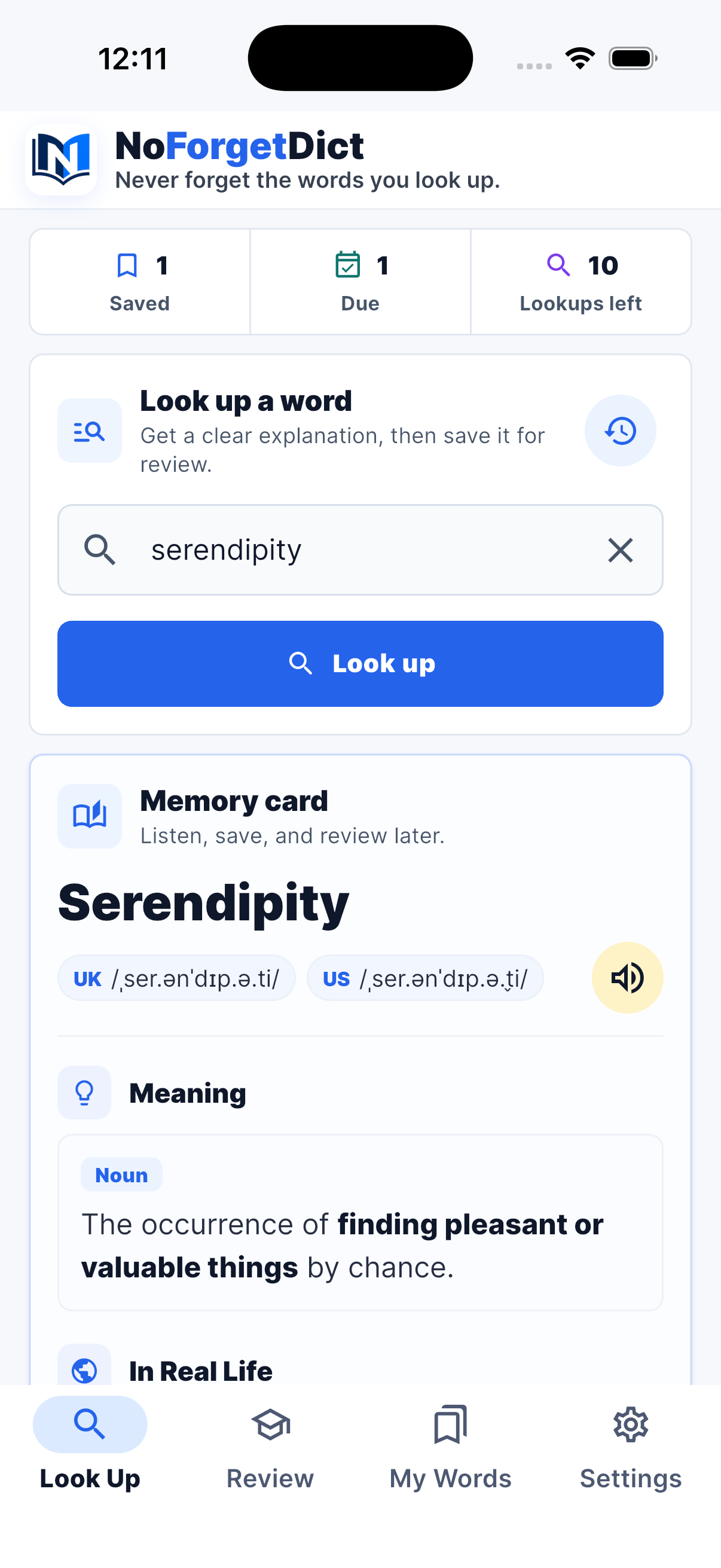
Example: turning “serendipity” into a retrievable memory
Meaning: finding something pleasant or valuable by chance.
Real-life context: unexpectedly meeting a useful contact in a café.
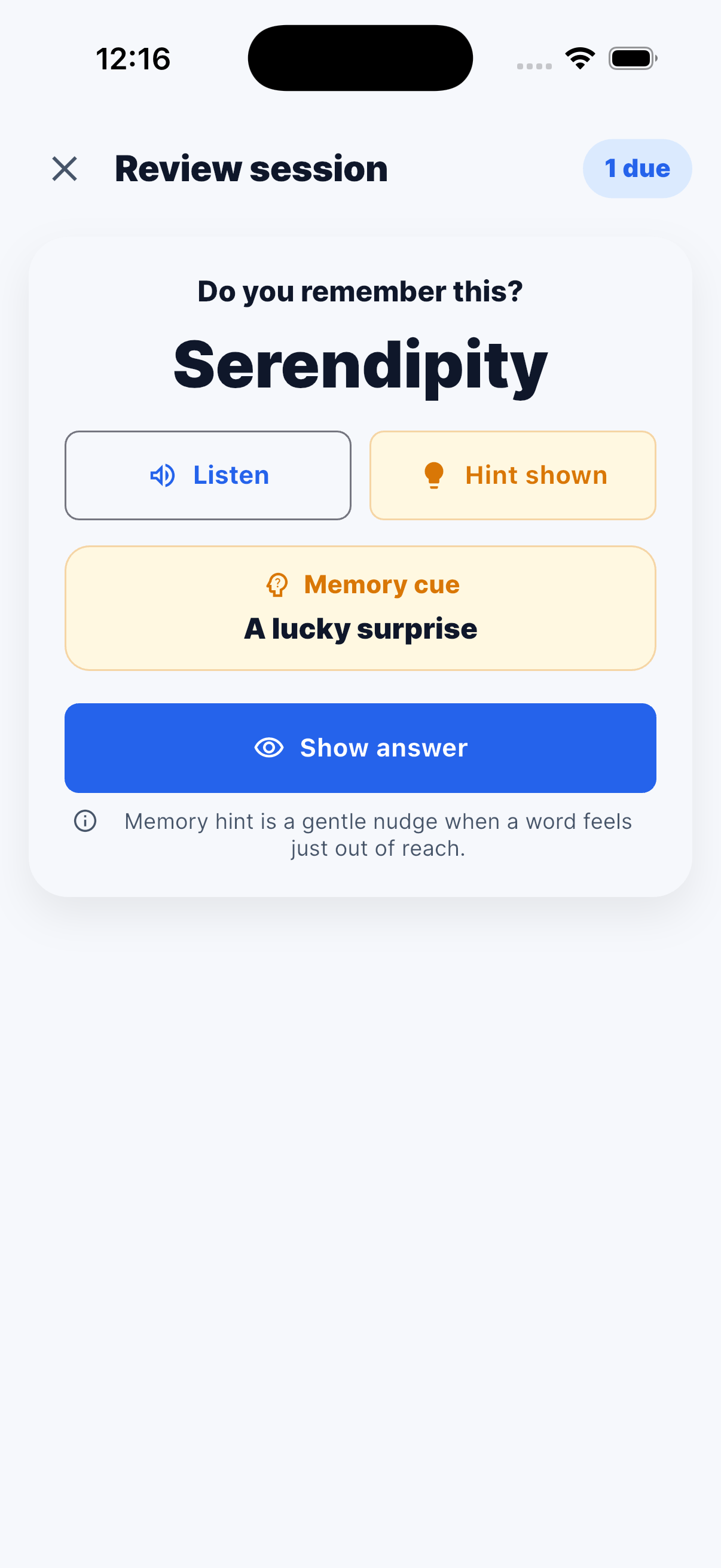
Memory cue: “A lucky surprise.”
Recall question: Before revealing the answer, ask yourself: “What kind of lucky accident does this word describe?”
The cue is not a replacement for the meaning. It is a gentle route back to it. Once you can recall the meaning without help, the cue becomes less important.
What to do when you forget the word again
Forgetting during practice is not proof that the method failed. It tells you that the connection is not stable yet. Reveal the answer, compare it with what you remembered, improve the cue if necessary, and bring the word back sooner.
In NoForgetDict, choosing Forget keeps the word in today’s review so you can strengthen it again. Choosing Remember moves it to the next interval:
After that, remembered words continue at 90-day intervals unless you mark them as mastered. This is NoForgetDict’s current product schedule, not a universal schedule that every learner must follow.
How many times should I review a new word?
There is no fixed number of reviews that works for every word or every learner. A familiar word may become easy to recall after a few successful reviews, while a difficult word may need more attempts over a longer period.
Focus on whether you can recall the meaning before seeing the answer. Then allow remembered words to wait longer and forgotten words to return sooner. The quality of each recall and the spacing between attempts matter more than chasing a magic repetition count.
Common mistakes that make vocabulary harder to retain
- Saving everything: an overloaded review queue makes it easier to abandon the habit.
- Copying a definition without context: you may recognise the wording but still not know when to use the word.
- Revealing the answer immediately: give yourself a few seconds to retrieve first.
- Using only a translation: a translation may confirm the basic meaning, while an example sentence can also show how the word is actually used.
- Reviewing only once: one successful recall does not mean the memory will remain accessible months later.
A simple routine you can start today
- When a useful unfamiliar word appears, look it up and read the meaning that fits the context.
- Say the meaning in your own words and notice one natural example.
- Save it with a short cue only if you want to remember it.
- At review time, pause and recall before showing the answer.
- Mark the result honestly. Let difficult words return sooner and familiar words wait longer.
If you prefer paper, the same method works with a notebook or flashcards. NoForgetDict’s role is to keep lookup, cue, saving, and scheduled review in one place so the follow-up is easier to maintain.
For details about review intervals, mastered words, syncing, offline behaviour, and limits, see the NoForgetDict vocabulary Q&A.
Sources and editorial note
This guide combines established learning research with NoForgetDict’s documented product workflow. It does not claim that one review schedule is optimal for everyone.
- Cepeda et al. (2006), review and quantitative synthesis of distributed practice.
- Karpicke and Roediger (2008), retrieval practice and long-term retention.
- Product behaviour and screenshots were checked against NoForgetDict version 1.4.0 on August 13, 2026.